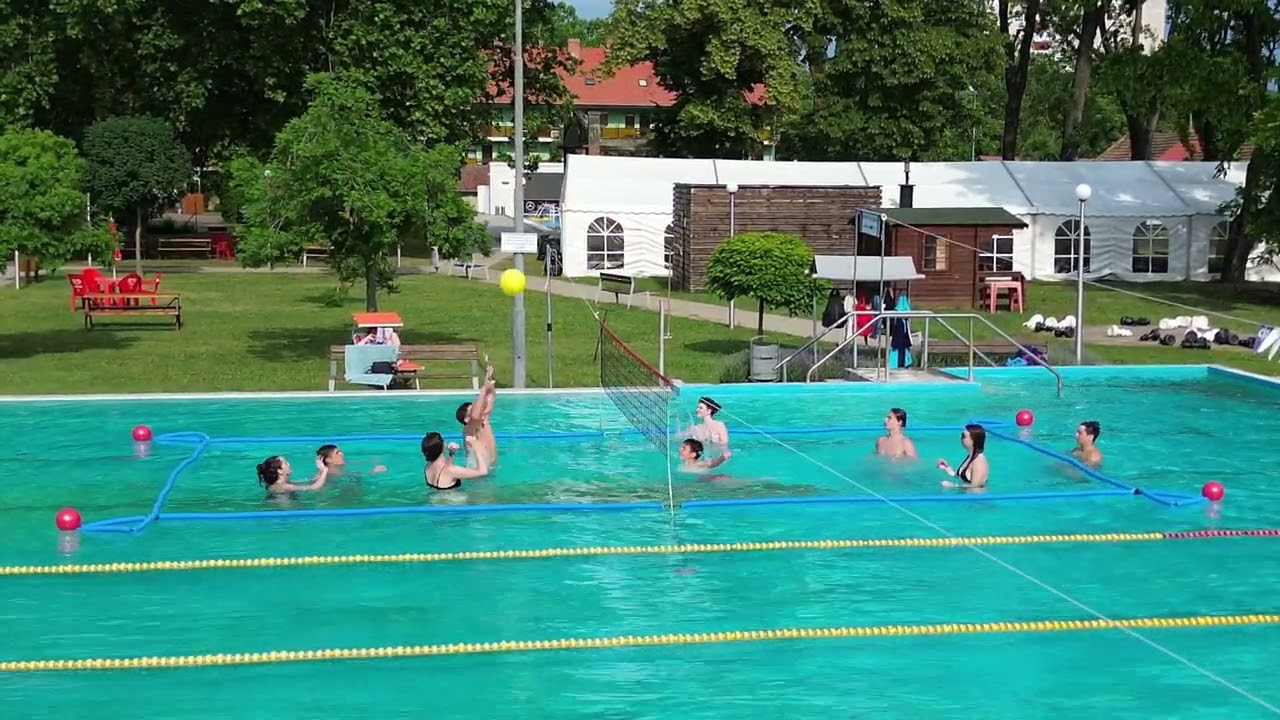
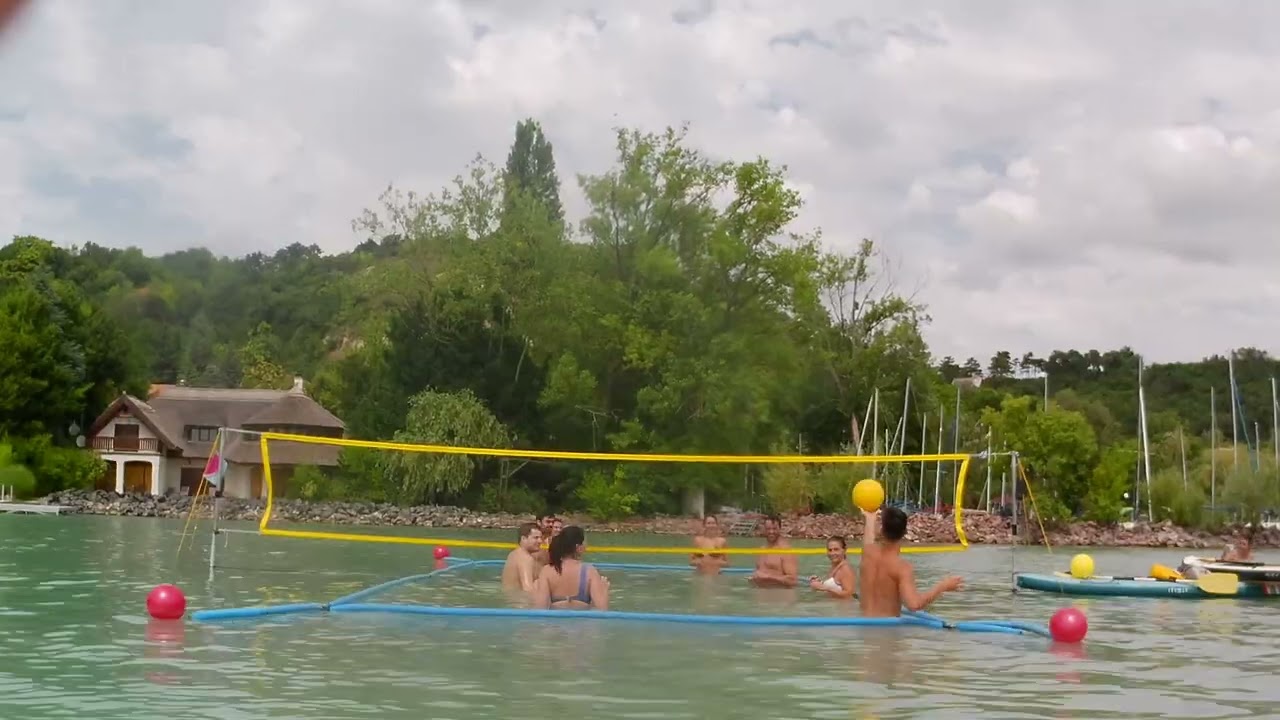
Six distinct ball games can be enjoyed on aQuolley courts — collectively known as the aQuolley sports. Below: the lineup, how each game adapts to water, and the full multilevel rule and eligibility framework behind aquolley (water volleyball).
Six distinct water sports can be enjoyed on aQuolley courts, collectively known as the aQuolley sports. Each has its own variations, rules and competition formats.
Because of its prevalence, only aquolley (water volleyball) receives detailed rule coverage here — the other five share the same courts, adjustable nets and shallow-water spirit.
Adapted ball games for shallow water — adjustable nets, special balls, scalable courts. Tap a card for the full description.
Water volleyball — the flagship game. Adjustable court sizes, a net and a special ball.
A special ball that bounces off the water's surface; net adjustable to 1.1 m.
Beach tennis adapted for water, using paddles and balls. Net 1.6–1.9 m.
Traditional rackets and shuttlecocks, optimized for an aquatic setting.
Based on beach handball — two goals and a special ball, optional thirds lines.
Built for water play with two goals and a special ball; optional center line.
Net-and-ball rallies, goal games, paddles or pure headers — two modular courts (a net court and a dual-goal court) flex to all six aQuolley sports. Pick the depth, set the net, choose your sides.
New to it? Start with aquolley, the water volleyball that gives this whole platform its name and the only game with a full rule set below.
Aquolley is a novel sport, developed from adapting traditional volleyball to the aquatic environment. It shares its origins with beach and snow volleyball, yet has evolved into a unique entity — defined by its own rules and attracting a specific audience.
The sport currently lacks a formal competition framework, but it holds the promise of achieving significant popularity, especially among the general public. Its design prioritized widespread participation over visual spectacle or commercial appeal — fun for everyone first, a competition circuit later.
Lifting a ball game into water means designing for surfaces that never stop changing.
In open water, every spot is different, and even a single location keeps changing. The bottom varies from place to place, its density and contours never quite the same. Depth shifts across the area, while wave height and intensity rise and fall through the day.
Pools bring their own challenges, with extra weight on the minimum space required (playing area plus safety zone) to keep the risk of serious injury low. They also tend to serve several activities at once, so the setup leans on shared-use solutions — splitting the space, or taking turns over time.
Every aQuolley court is designed so the fun never comes at the expense of safety.
Playing in very shallow water is genuinely dangerous — an uneven bottom can hide holes and rises. A minimum depth of 0.6 m is required for enough resistance and cushioning; the practical maximum is 1.3 m for an average 1.8 m player.
Casual groups may equate the playing edge with the water's boundary, but at institutional venues that's a real injury risk. A 1 m safety margin must surround the field — so an 8×4 m field sets the minimum footprint at 10×6 m.
Heavier balls can readily injure recreational players' hands and fingers, and weaken the grip of the ground screws in the sand over time. A lightweight plastic ball — ideally 0.26 m diameter, ~280 g — is essential. Two balls come with every set, with extras available on request.
Two levers keep the game fair and fun: an adjustable 3+1 D setup, and rules that adapt to the water.
aQuolley offers 3+1 D versatility. Three dimensions are the court itself: net height adjusts to the water's depth — more response time, a slower ball — while length and width scale to squad size. The fourth dimension is the ball: reach for a bigger, lighter or slower one and a rally instantly becomes easier to join. Together they tune the game to the players, the water and the format.
Water-specific tweaks keep rallies alive: cupped-hand contact is allowed for receives and sets, with fingertip touches for drop shots, and any body part may contact the ball — save for throws or double contacts. A serve reception must precede an internal pass before the ball's return; serves that touch the net but land in play are replayed.
Despite knee and hip injuries from professional football tennis, a determined father at Lake Balaton sought sportslike leisure with his young daughters. Within a week a net stood tall, and the game — enhanced by floating court lines — became an instant hit with locals and vacationers.
An engineer friend joined the endeavor, contributing to the creation of the first 3D-adjustable aquatic court, which he patented and trademarked as aQuolley. Trials took place in several countries, and aquolley.com launched.
More and more locations adopted aQuolley courts, with strong YouTube interest following the games from venue to venue.
Adaptable courts were engineered by late 2024 for open water and early 2025 for pools — flexible enough for any shifting bottom or shared venue.
A multilevel rule system plus an eligibility framework: base rules, six disciplines, eleven categories, and player groupings — all detailed for aquolley (water volleyball).
The Base Rules follow beach volleyball, with a handful of water-specific exceptions that keep play fair and rallies alive:
For large fields the competition director may shorten play (sets to 11, no third set, no two-point requirement), and may shift start and finish times for weather, water temperature or wind.
Aquolley features six disciplines. Discipline Rules specify team sizes, on-court player numbers and court dimensions for each, with adjustments for water play.
| Discipline | Players + subs | Court area | Timeouts | Sub windows | Players / sub |
|---|---|---|---|---|---|
| Singles | 1 | 8×4 m | 1 | – | – |
| Doubles | 2+1 | 9×4 m | 2 | 2 | 1 |
| Triples | 3+2 | 10×5 m | 2 | 2 | 1 |
| Fours | 4+2 | 11×5 m | 2 | 2 | 2 |
| Fives | 5+2 | 12×5 m | 2 | 2 | 2 |
| Sixes | 6+3 | 12×6 m | 3 | 3 | 3 |
| Water depth | Women's | Mixed | Men's |
|---|---|---|---|
| 0.6–0.9 m | 2.35 m | 2.4 m | 2.45 m |
| 0.9–1.1 m | 2.45 m | 2.5 m | 2.55 m |
| 1.1–1.3 m | 2.55 m | 2.6 m | 2.65 m |
Disciplines are delineated by gender composition into women's, men's and mixed categories. With the core concept emphasizing mixed team play, this yields eleven distinct match categories.
| Category | Players | Subs | Court area | Net* | Requirement |
|---|---|---|---|---|---|
| Women's Singles | 1 | 0 | 6×3 m | 2.45 m | Women only |
| Men's Singles | 1 | 0 | 8×4 m | 2.55 m | Open to all |
| Women's Doubles | 2 | 1 | 6×4 m | 2.45 m | Women only |
| Mixed Doubles | 2 | 1 | 8×4 m | 2.5 m | Min. 1 woman |
| Men's Doubles | 2 | 1 | 9×4 m | 2.55 m | Open to all |
| Women's Triples | 3 | 2 | 8×4 m | 2.45 m | Women only |
| Mixed Triples | 3 | 2 | 9×4 m | 2.5 m | Min. 1 woman |
| Men's Triples | 3 | 2 | 10×5 m | 2.55 m | Open to all |
| Fours | 4 | 2 | 11×5 m | 2.5 m | Min. 1 woman |
| Fives | 5 | 2 | 12×5 m | 2.5 m | Min. 2 women |
| Sixes | 6 | 3 | 12×6 m | 2.5 m | Min. 2 women |
* Net heights shown apply to 0.9–1.1 m water depth; see the Net Heights table above for other depths.
"Men's" categories are open to all genders. All-male teams are fine, but teams of any gender composition are just as welcome — the goal is to widen participation.
A team made up entirely of women, boys under 16, or players over 55 may field one additional player on the court. This benefit is not cumulative.
Competition categories group players by skill and age; competition classes define who may enter — all in a deliberately relaxed, friendship-first spirit. Every team member must meet the criteria for the chosen category and class.
Professional · Semi-Professional · Amateur.
Absolute · Youth (<18) · Junior (<25) · Senior (50+).
Federal · Club · Family.
Friendship first — a relaxed, trust-based atmosphere.
The complete rule specification — base rules, all six disciplines, the eleven categories and the full eligibility framework — beyond the summary shown on this page.
Az oldalon belüli lejátszás http-ről működik — most file://-ből nyitottad meg.
Indítsd a helyi szerverről: http://localhost:8765/ (az éles oldalon, https-en automatikusan megy).